Best Kajabi Alternatives (2026): 9 Options for Courses, Coaching and Community
Compare the best Kajabi alternatives by pricing model, transaction fees and features, from Teachable and Thinkific to Circle, Payhip and a WordPress membership site you own.


The best Kajabi alternatives are Teachable, Thinkific and LearnWorlds for course-first businesses, Podia and Payhip for a cheaper all-round store, Circle and Mighty Networks for community-led programs, and a WordPress site with a membership plugin if you want to own the platform. Kajabi starts at $143/month billed yearly as of October 2026, so most people who switch want a lower bill or fewer plan caps.
Ultimate Membership Pro is made by WPIndeed, the publisher of this blog.
Kajabi alternatives are platforms that replace some or all of Kajabi’s toolkit: courses, coaching, community, email marketing, funnels, a website and a mobile app. Some copy the whole bundle at a lower price. Others do one job well and expect you to add the rest.
- Kajabi charges a plan fee and says it takes no revenue share. Card processing applies, plus 2% to 0.5% by plan if you connect Stripe directly (as of October 2026).
- Teachable Builder (with Teachable Payments), Podia Shaker, Payhip Pro, LearnWorlds Pro Trainer and Systeme.io take no platform fee on sales. Circle and Mighty Networks charge one on every plan.
- WordPress with Ultimate Membership Pro and Ultimate Learning Pro gives you your own site and gateway. You add an email tool and run the hosting.
- Entry prices can mislead. At $3,000 in monthly sales, Payhip Plus costs $89 a month in platform fees, Kajabi Basic $143 and Teachable Starter $254, before card processing (worked example below).
Why do creators look for Kajabi alternatives?
Most creators look for Kajabi alternatives because of cost, plan caps and paying for tools they don’t use.
- Price. As of October 2026, Basic costs $179/month or $143/month billed yearly, Growth $249 or $199, and Pro $499 or $399.
- Plan caps. Basic allows 5 products, 2,500 contacts, 1 website and 1 community. Extra contacts come in blocks of 25,000 for $125/month.
- Payment fees. Kajabi Payments charges 2.9% + $0.30 per card payment on Basic for U.S. accounts. Connecting your own Stripe account instead adds 2% on Basic, 1% on Growth or 0.5% on Pro; PayPal is excluded.
- Unused tools and add-ons. Funnels, landing pages and marketing emails are unlimited on every plan, AI credits start on Growth (500 a month), and the branded mobile app is included only on Pro, where Kajabi lists it as a $199/month value. If you mainly sell one course, you pay for tools you don’t use.
Kajabi alternatives at a glance
This table compares nine Kajabi alternatives, with Kajabi in the first row as the baseline. Prices and fees were checked on each vendor’s site as of October 2026, and card processing applies to every option.
| Option | Pricing model | Platform fee on sales | Best for |
|---|---|---|---|
| Kajabi (baseline) | From $143/month billed yearly | No revenue share; 2% on Basic with your own Stripe | Courses, email, funnels and an app in one bill |
| Ultimate Membership Pro + Ultimate Learning Pro | Annual plugin plans plus your own hosting | Your payment processor’s fees | Courses and Memberships on a site you own |
| Teachable | From $29/month billed yearly | 7.5% on Starter; 0% from Builder with Teachable Payments | Course-first creators on a budget |
| Thinkific | From $82/month billed yearly | None with Thinkific Payments; extra fee with Stripe or PayPal | Many courses and structured learning |
| Podia | From $42/month billed yearly | 5% on Mover; none from Shaker | Courses, downloads and coaching in one store |
| Systeme.io | Free plan; paid from $17/month | 0% on every plan | Tight budgets that need funnels and email |
| LearnWorlds | From $24/month billed yearly | $5 per paid enrollment on Starter; none from Pro Trainer | Course academies with a built-in community |
| Circle | From $89/month billed yearly | 2% down to 0.5% by plan | Community-led courses and cohorts |
| Mighty Networks | From $79/month billed yearly | 2% down to 0.5% by plan | Community memberships with events |
| Payhip | Free plan; paid from $29/month | 5% Free, 2% Plus, none on Pro | The cheapest start for courses and downloads |
What are the best Kajabi alternatives?
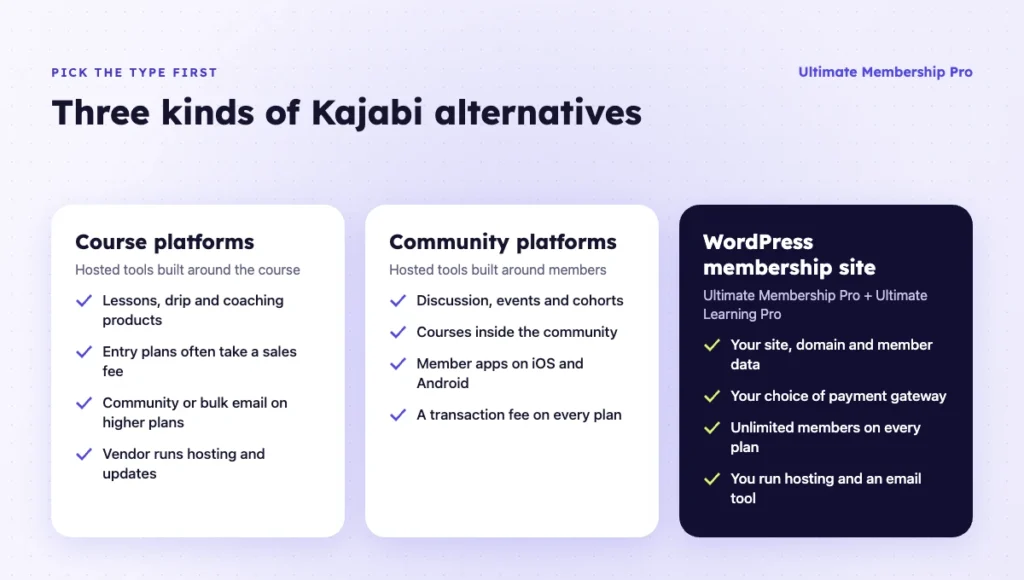
The best Kajabi alternatives depend on what earns your revenue. Most fall into three groups: course platforms, community platforms and a WordPress membership site you run yourself. Systeme.io and Payhip sit at the budget end of the course group.
1. Ultimate Membership Pro and Ultimate Learning Pro on WordPress
Ultimate Membership Pro is a WordPress membership plugin. You sell course access as a Membership, take payments through gateways such as Stripe and PayPal, and keep every page on your own domain, with unlimited members on every plan.
For lessons, quizzes and certificates you add Ultimate Learning Pro, a separate WPIndeed course plugin sold on its own. Its site lists timed quizzes, certificates, progress stats, points, badges and multiple instructors per course. In the online course setup, you link each course to a Membership, and the course and its curriculum are restricted together.
Students can pay monthly or yearly, in installments, or once for permanent access, with an optional trial. Drip content opens each lesson page days, weeks or months after a student joins, or on a date, and the Drip Content Notifications add-on emails students when a lesson opens.
Best for: creators who want courses, Memberships and member data on their own WordPress site, with no member caps.
Limitation: it is two plugins plus tools you pick yourself. There is no email campaign tool, funnel builder, forum or mobile app built in, and you run hosting, updates and backups.
Ultimate Membership Pro is sold as annual plans (Pro, Full Package and Agency), listed on the pricing page. Pro covers Memberships, drip content, recurring billing through 10 gateways and the Member Portal. Full Package adds PayFast, Paystack and Razorpay, group memberships and the ConvertKit integration. Payment processor fees still apply.
2. Teachable
Teachable is a hosted course platform that also sells coaching, digital downloads and memberships. There is no free plan. Starter costs $29/month billed yearly with a 7.5% transaction fee and 5 products; Builder costs $69/month billed yearly, with 0% through Teachable Payments and 10 products.
Memberships and bundles don’t count toward the product cap. Students get iOS and Android apps, and community starts on Builder.
Best for: course creators who want a lower entry price and a focused course builder.
Limitation: product caps apply on every plan, and Starter’s 7.5% fee gets expensive as sales grow.
3. Thinkific
Thinkific is a hosted course platform with unlimited published courses, digital downloads and coaching products on every plan. There is no free plan, only a 30-day trial. Start costs $82/month billed yearly with 1 community, and Grow costs $164/month with 3 communities and bulk email.
Processing through Stripe or PayPal directly adds a third-party gateway fee that varies by plan, which Thinkific Payments avoids. A branded mobile app is a $199/month add-on.
Best for: course businesses that need many courses and structured learning.
Limitation: the entry plan sits closer to Kajabi’s price than most options, and the branded app costs extra.
4. Podia
Podia is an all-in-one creator store for courses, downloads, coaching, community, webinars, a website and email. Mover costs $42/month billed yearly with a 5% transaction fee and 50 products. Shaker costs $84/month billed yearly with no Podia fee, 150 products and affiliate marketing.
Best for: solo creators who sell a mix of courses, downloads and coaching from one simple dashboard.
Limitation: included email subscribers are small (100 on Mover, 500 on Shaker), and the pricing page lists no mobile app.
5. Systeme.io
Systeme.io bundles courses, a community builder, email marketing, sales funnels, a website and blog, webinars and an affiliate program. Its free plan never expires and includes 2,000 contacts, 3 funnels and 1 course. Paid plans cost $17, $47 and $97 per month, and every plan has 0% transaction fees.
Best for: the lowest-cost way to keep funnels, email and courses in one tool.
Limitation: lower plans cap courses (1 on Free, 5 on Startup, 20 on Webinar) and contacts, and the pricing page lists no mobile app.
6. LearnWorlds
LearnWorlds is a hosted course platform with unlimited paid courses, video hosting, a website on your own domain and a built-in community on every plan. As of October 2026, Starter costs $24/month billed yearly plus $5 per paid enrollment, and Pro Trainer costs $79/month billed yearly with no enrollment fees.
Plans cap active learners per month: 1,000 on Starter and 2,000 on Pro Trainer. Mass email credits start on Pro Trainer, and a branded mobile app is a paid add-on from that plan up.
Best for: course businesses that want lessons and a learner community on one platform.
Limitation: the $5 enrollment fee on Starter adds up on low-priced courses, and the active-learner caps push growing schools to higher plans.
7. Circle
Circle is a community platform with courses, live events and payments in one place. Professional costs $89/month billed yearly with a 2% transaction fee, Business $199 with 1%, Scale $419 with 1%, and Circle Plus has custom pricing with 0.5%. Members use Circle’s iOS, Android and desktop apps; custom branded apps come only with Circle Plus.
Best for: community-led programs and cohorts where discussion matters as much as lessons.
Limitation: every plan has a transaction fee, and email marketing (Email Hub) is a $99/month add-on below Circle Plus.
8. Mighty Networks
Mighty Networks combines community, courses and online or in-person events. As of October 2026, Launch costs $950/year (about $79/month) or $95 month to month, with a 2% transaction fee. Scale costs $179/month billed yearly with 1%, and Growth $354/month billed yearly with 0.5%. Members use the Mighty app on iOS and Android, and branded apps need Mighty Pro.
Best for: community memberships where members meet, post and attend events.
Limitation: a transaction fee applies on every plan, and branded apps need custom Mighty Pro pricing.
9. Payhip
Payhip is a creator store for digital downloads, online courses, coaching, memberships and physical products, with email marketing and a store builder. Every plan has the same features and differs only by fee: Free Forever charges 5% per sale, Plus costs $29/month with 2%, and Pro costs $99/month with no transaction fee.
Best for: the cheapest start, especially if you sell courses next to downloads.
Limitation: the free and Plus plans take a share of every sale, and the pricing page lists no community features.
How do Kajabi alternatives compare on features?
Every option here sells courses. The gaps show up in community, email and apps, based on each vendor’s pricing and feature pages as of October 2026.
| Option | Community | Email marketing | Website | Mobile app |
|---|---|---|---|---|
| Kajabi | 1 on Basic | Unlimited marketing emails | Yes | Kajabi apps; branded app on Pro only |
| WordPress with both WPIndeed plugins | Member directory; add a forum plugin locked by Membership | 45+ notifications; campaigns via your email tool | Your WordPress site | No |
| Teachable | Builder and up | Listed on all plans | Site builder | iOS and Android student apps |
| Thinkific | 1 on Start, 3 on Grow | Automations; bulk email from Grow | Yes | Branded app add-on |
| Podia | Yes | Yes, small subscriber allowance | Yes | Not listed |
| Systeme.io | Yes | Unlimited emailing | Website and blog | Not listed |
| LearnWorlds | Built in on every plan | Mass email from Pro Trainer | Yes, on your own domain | Branded app add-on |
| Circle | Core product | Email Hub add-on | Community site | Circle apps; branded on Circle Plus |
| Mighty Networks | Core product | Via integrations such as Kit | Community site | Mighty app; branded on Mighty Pro |
| Payhip | Not listed | Yes | Store builder | Not listed |
What are the cheapest Kajabi alternatives?
Payhip and Systeme.io are the cheapest Kajabi alternatives to start with, since both have free plans. Payhip’s free plan takes 5% of each sale, while Systeme.io’s has no sales fee and allows 1 course. As sales grow, a flat plan with no platform fee usually costs less.
This worked example shows monthly platform cost at three sales levels, using yearly-billed prices and fees as of October 2026. It leaves out card processing, which you pay everywhere: Kajabi Payments lists 2.9% + $0.30 on Basic, the same as Stripe’s standard U.S. card rate on its pricing page.
| Monthly sales (example) | Kajabi Basic | Teachable Starter ($29 + 7.5%) | Podia Mover ($42 + 5%) | Payhip Plus ($29 + 2%) | Circle Professional ($89 + 2%) |
|---|---|---|---|---|---|
| $1,000 | $143 | $104 | $92 | $49 | $109 |
| $3,000 | $143 | $254 | $192 | $89 | $149 |
| $10,000 | $143 | $779 | $542 | $229 | $289 |
The no-fee tier of the same platform wins early. Teachable Builder ($69, with Teachable Payments) beats Starter above about $530 in monthly sales, Podia Shaker ($84) beats Mover above about $840, and Payhip Pro ($99) beats Plus above $3,500.
A WordPress site has fixed yearly costs instead of a share of sales. To weigh it against hosted Kajabi alternatives on equal terms, add up:
- Hosting, a domain and a theme.
- An Ultimate Membership Pro plan: Pro or Full Package, depending on the gateways and add-ons you need (see the plan notes in the first profile).
- Ultimate Learning Pro, sold separately, if you need quizzes, certificates and progress tracking.
- An email marketing tool for campaigns, plus card processing from Stripe or PayPal.
Set that total against a year of Kajabi Basic, which is $1,716 billed yearly as of October 2026.
Kajabi vs a WordPress membership site: what do you give up?
Moving from Kajabi to WordPress means giving up the all-in-one bundle: built-in email campaigns, funnels, a native app and hosted maintenance. In return, you get your own site and database, your choice of payment gateway and no caps on members or Memberships.

- Email marketing. Ultimate Membership Pro sends 45+ email notifications, such as payment completed and expiry warnings. Opt-in integrations add members to Mailchimp, AWeber, GetResponse or ActiveCampaign, and your email marketing tool sends campaigns.
- Mobile app. There is no native app. Students use your site and account page in a mobile browser.
- Funnels. There is no funnel builder. You build sales pages with a page builder such as Elementor or Divi.
- Community. There is no forum, chat or activity feed. You get a members-only directory, a BuddyPress tab that shows each member’s account page in their profile, and Membership rules that lock the pages of the forum plugin you choose.
- Maintenance. You handle hosting, updates, backups and security.
What you gain is control. Pro includes 10 payment gateways (13 in Full Package), and recurring subscriptions support coupons, trials, installments and prorated upgrades. In the Member Portal, students renew, cancel and print invoices, and with Stripe Connect they update their card.
Which Kajabi alternative should you choose?
Start from what earns most of your revenue, then trial two or three of these platforms side by side.

Best Kajabi alternative for courses
Teachable and Thinkific are built around the course itself. Pick Teachable for a lower entry price, Thinkific for many courses on one plan, or LearnWorlds if you want a learner community inside the course platform. On WordPress, Ultimate Learning Pro adds quizzes and certificates, and Ultimate Membership Pro sells access.
Kajabi alternative for coaching
Podia, Teachable and Thinkific all sell coaching products. On WordPress, the coaching setup bills clients monthly or for 2 to 52 payments and gives each client a private page. It doesn’t book sessions or host calls, so you link your booking tool from the client area.
Kajabi alternatives for community-led programs
Circle and Mighty Networks are the strongest picks when members come for each other as much as for the lessons. Both charge a transaction fee on every plan, so include it in the yearly cost.
Skool is a simpler option built around one community with courses and live calls. As of October 2026, Hobby costs $9/month with a 10% transaction fee and Pro costs $99/month with 2.9%. It suits a single focused group better than a catalog of courses.
A cheaper Kajabi alternative on a tight budget
Start on Payhip’s or Systeme.io’s free plan, then move to a no-fee tier once sales cover it. Systeme.io is the closer match if you rely on Kajabi’s funnels and email.
When Kajabi is still the better fit
Stay on Kajabi if you use most of the bundle: email campaigns, funnels, community, podcasts and the app. Rebuilding that stack from separate tools can cost more than one Kajabi plan, and each extra tool adds another login and bill.
How do you move from Kajabi without losing students?
Whatever you switch to, export your contacts and course files first, rebuild the courses, then plan how paying students move. Keep Kajabi running until every subscription has a clear next step.
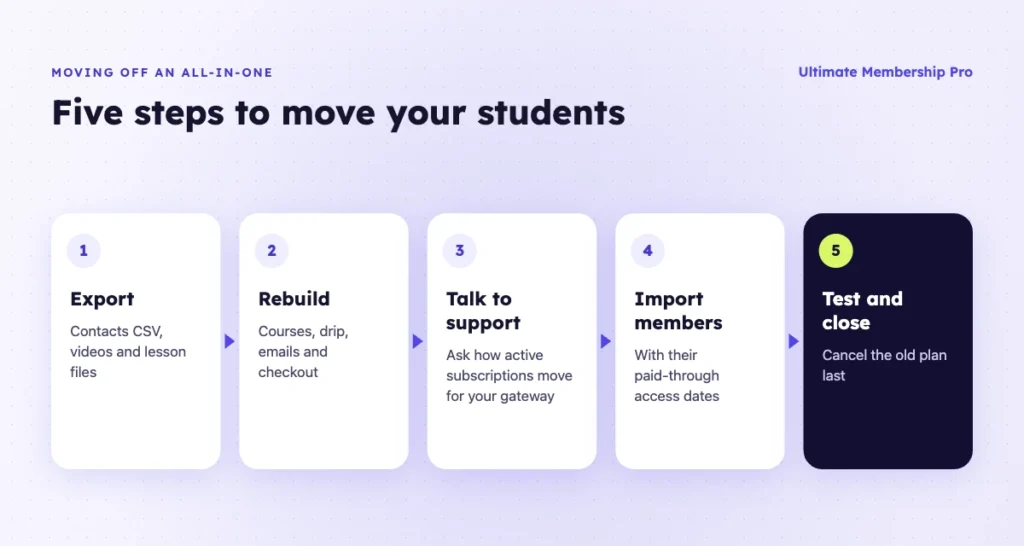
- Export. In Kajabi, open Contacts, select everyone and choose Export under Bulk Actions. Kajabi emails you a CSV of contacts and customers; the link expires after 3 days. Download videos and lesson files too.
- Rebuild. Recreate courses, access levels, drip schedules, checkout pages, email automations and funnels in the new tools.
- Talk to support. If you move to WordPress, the Ultimate Membership Pro support team helps you migrate from Kajabi with its own tools. Before you set a date, ask them how your active recurring subscriptions will be handled for your payment gateway.
- Import members. Import contacts into your email tool and students into the new platform with the access dates they’ve paid for, then email students the new login link.
- Test and close. Move a few students first and test a sign-up, a lesson, a renewal and a cancellation. Cancel Kajabi only after every paying student has moved or their access has ended.
What happens to paying subscribers?
Kajabi Payments runs on Stripe’s processing engine, but the billing relationship sits inside Kajabi. Its help center describes moving subscriptions into Kajabi Payments, not out, so ask Kajabi support what payment data you can take before you set a date.
Subscriptions on your own connected Stripe account live in that account. Kajabi warns that customers on a detached processor lose the Billing Info section, so you cancel or update their cards by hand.
The standard CSV member import covers accounts and access: each row takes a Membership with start and expiry dates. On its own, the import doesn’t create orders or gateway subscriptions, which is why the support conversation in step 3 comes first for recurring billing: the answer depends on where those subscriptions run today.
Ready when you are
Turn visitors into paying members with Ultimate Membership Pro
Launch your membership website, protect exclusive content and automate subscription payments, all in one WordPress plugin.
- 14-day money-back guarantee
- Unlimited members
Frequently asked questions
What is the best alternative to Kajabi?
It depends on what you sell. Teachable, Thinkific and LearnWorlds suit course-first businesses, Podia and Payhip suit creators who sell courses next to downloads and coaching, and Circle and Mighty Networks suit community-led programs. A WordPress site with Ultimate Membership Pro, plus Ultimate Learning Pro for lessons, suits creators who want to own the site, the member data and the payment account.
Is there a cheaper Kajabi alternative?
Yes. As of October 2026, Kajabi starts at $143/month billed yearly. Payhip and Systeme.io have free plans, and Teachable Starter costs $29/month billed yearly. Check the sales fee too: Payhip Free takes 5% and Teachable Starter 7.5%, so a no-fee plan is often cheaper once sales grow.
Does Kajabi take a percentage of sales?
Kajabi says it takes no revenue share. You pay card processing through Kajabi Payments, listed at 2.9% + $0.30 on Basic for U.S. accounts as of October 2026. If you connect your own Stripe account instead, Kajabi adds a fee of 2% on Basic, 1% on Growth or 0.5% on Pro. PayPal is excluded from that extra fee.
Can I use WordPress instead of Kajabi?
Yes. A WordPress site is a Kajabi alternative you own. Ultimate Membership Pro sells course access as Memberships, bills through Stripe, PayPal and other gateways, and drips lessons over time. Ultimate Learning Pro adds quizzes and certificates. You add an email tool for campaigns and handle hosting, updates and backups yourself.
Kajabi vs Teachable: which is better for courses?
Teachable is cheaper to start, at $29/month billed yearly on Starter as of October 2026, and focuses on courses, coaching and downloads, with product caps on each plan. Kajabi costs more and adds funnels, unlimited marketing emails and a branded app option. Pick Teachable if courses are the business, and Kajabi if you rely on its marketing tools.
Can I move my students and subscriptions from Kajabi?
You can export contacts and customers from Kajabi as a CSV file and download your course files. Kajabi Payments keeps the billing relationship inside Kajabi, so plan subscriptions with care. If you move to WordPress, the Ultimate Membership Pro support team helps you migrate with its own tools; ask them how your active recurring subscriptions will be handled for your payment gateway.