Membership Referral Program: How to Design, Reward and Launch One
How to design a membership referral program: who can refer, referral rewards for both sides, payout timing, fraud rules, examples, metrics and a WordPress setup.

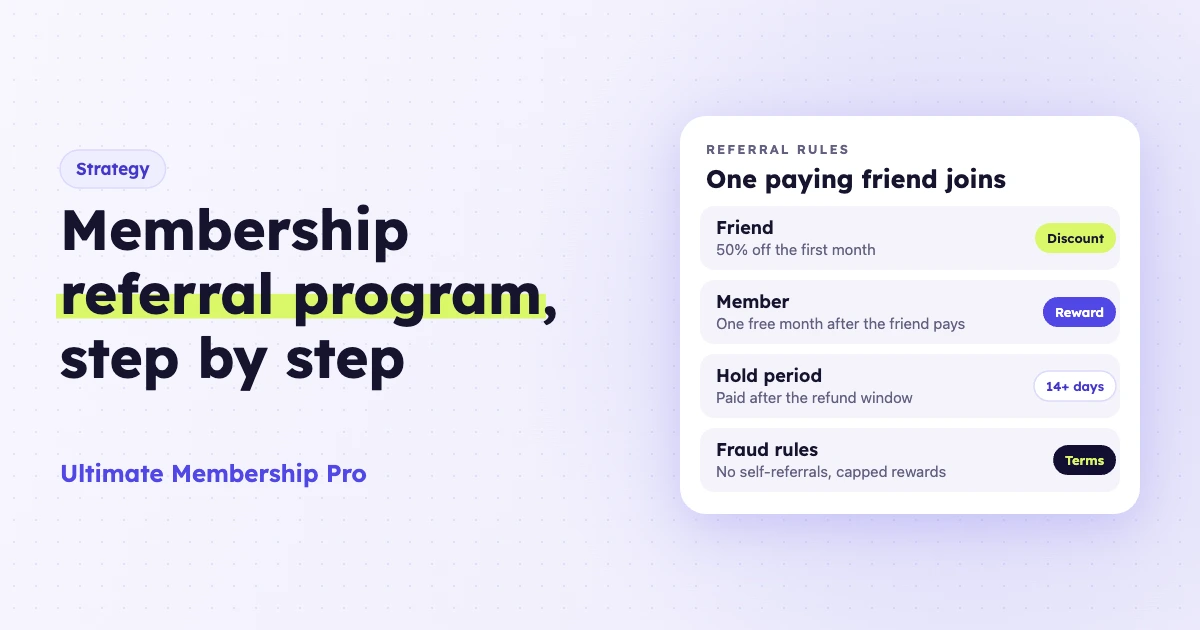
A membership referral program rewards your current members when a friend they invite joins and pays. To build one, decide who can refer, pick a reward for the referrer and often one for the friend, hold rewards until the refund window closes, add a few fraud rules, then put the invite link where members already are: the account page, the welcome email and renewal emails.
A friend who joins on a member’s word already knows what the membership offers. And unlike ads, which you pay for up front, a referral reward costs you something only when the friend pays.
Key takeaways
- Start small: one reward, one share link and one page of rules beat a complex points system.
- Pay late: release rewards only after the friend’s first paid charge clears and the refund window closes.
- Reward both sides: a member-get-member offer gives the friend a reason to join and the member an easy way to ask.
- Measure monthly: participation, referral conversion, share of new members from referrals and how long referred members stay.
What is a membership referral program?
A membership referral program is a set of rules that rewards members for bringing in new paying members. Each member gets a personal link or code, and when someone joins through it, the member earns the reward you promised.
Every program has three parts: the referrer (an existing member), the friend (the new member) and the reward. The rewards can go one way or both ways.
- One-sided: only the referrer earns, for example a free month for each friend who joins.
- Double-sided: both people earn, for example the friend gets the first month free and the referrer gets a credit. Associations often call this member-get-member, or member-get-a-member.
- Tiered: the reward grows with the number of referrals, for example a free month after one friend and an upgrade after three.
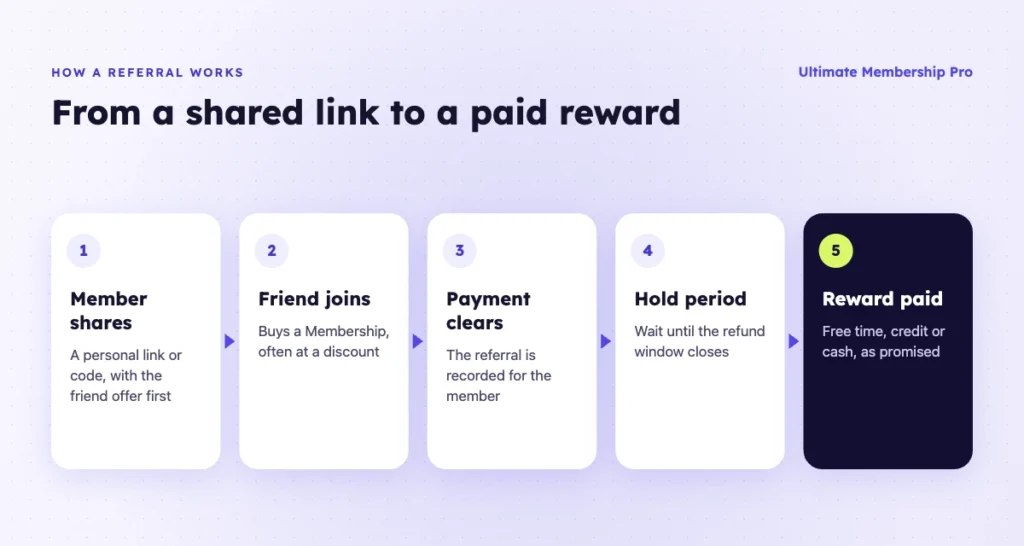
Here is how a single referral moves from link to reward.
How is a member referral program different from an affiliate program?
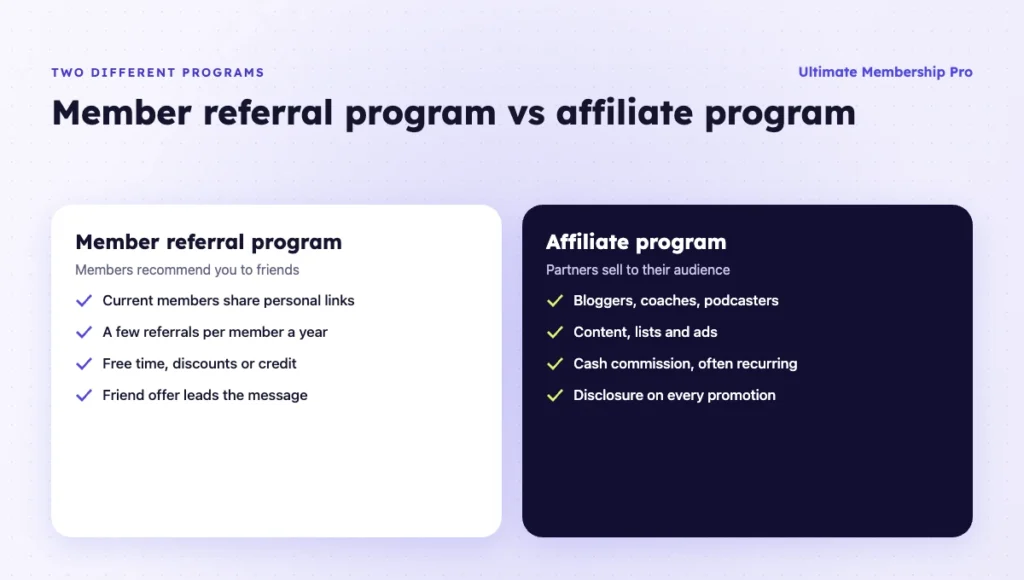
A member referral program rewards customers for personal recommendations. An affiliate program pays partners, such as bloggers, coaches or podcasters, a commission for selling to their audience. The tracking can be the same; the people, rewards and rules differ.
| Point | Member referral program | Affiliate program |
|---|---|---|
| Who promotes | Your current members | Partners with an audience |
| How they share | Personal messages, one friend at a time | Content, email lists, ads |
| Typical reward | Free time, discounts, credit, small perks | Cash commission, often on every renewal |
| Typical volume per person | A few referrals a year | Dozens or hundreds |
| Who needs to know it’s rewarded | Every friend the member asks | Every reader of the promotion |
You can run both at once. Keep the member offer simple and generous to the friend, and keep cash commissions and longer cookie windows for partners who bring real volume.
Is your membership ready for a referral program?
You are ready when members already recommend you without being asked, because a referral program rewards and tracks word of mouth more than it creates it. Check three signs:
- New members mention friends. Add a “How did you find this site?” question to sign-up, and look for answers like “a friend” or a member’s name.
- Members stay past the first few months. If most cancel early, fix onboarding first, or rewards will bring in people who leave just as fast.
- Your price leaves room for a reward. A free month or a discount has to cost less than what a new member pays you over their first months.
How do you design a member referral program?
Design comes down to six decisions: who can refer, what the referrer earns, what the friend gets, when rewards are paid, how rewards grow and which fraud rules apply. Write each one down before you build anything.
Who can refer?
Make paying members the referrers by default, once their own first payment has cleared. That stops people from joining, referring themselves and canceling.
If you also run a free Membership, open the program to free members only when every reward waits for the friend’s payment, as the payout rules below require.
Which referral rewards work best?
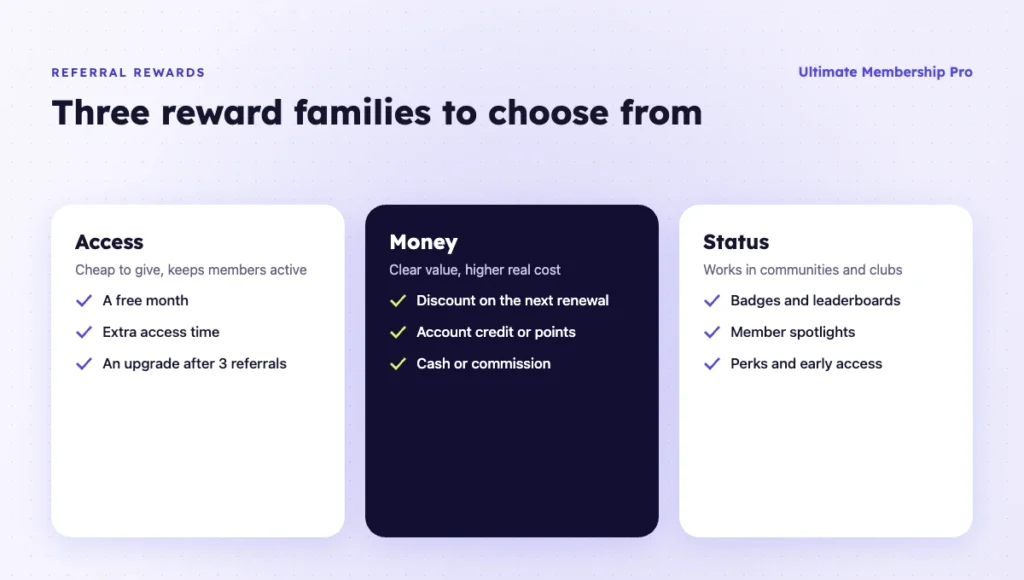
The best referral rewards cost you little, matter to the member and tie back to the membership itself. Free time or credit often suits members better than cash, because it keeps them paying and using the site.
| Reward | Real cost to you | Best for | Watch out for |
|---|---|---|---|
| Free month or extra access time | Low: you deliver access you already have | Monthly content and community memberships | Members on annual plans value it less |
| Discount on the next renewal | One payment at a lower price | Annual memberships and associations | Gateways handle discounts on existing subscriptions differently |
| Account credit or points | Only when redeemed | Sites that sell extras, events or shop items | Needs a place to spend it |
| Cash or commission | The full amount, plus payout fees | High-value plans and members with audiences | Feels transactional, invites gaming, may need tax paperwork |
| Perks and recognition | Small | Associations, clubs and communities | Must be something members want, not filler |
| Tiered rewards | Grows with results | Programs with a few very active referrers | Too many tiers confuse people |
Keep the total reward well below what a new member brings in. A simple test: the referrer’s reward plus the friend’s offer should cost less than the first two or three payments of a typical member.
Should rewards be double-sided?
Yes, in most memberships. A double-sided offer turns the ask into a gift: the member passes on a discount instead of making a sales pitch. Lead with the friend’s reward in every share message, and mention the referrer’s reward second.
A common pairing is a free first month for the friend and free time or credit for the member after the friend pays. The real example further down shows a large membership organization that pairs an offer for the friend with a reward for the member, paid only after a hold.
When should you pay out referral rewards?
Release a reward only once the friend can no longer get their money back. With a 14-day refund policy, that is day 15 after the friend’s first paid charge at the earliest.
Cash calls for a choice about risk. Card networks typically allow cardholders to dispute a payment within 120 days, according to Stripe’s guide to how disputes work. Holding cash that long removes most of the risk, but the reward then feels far away. A 30 to 60 day hold is a middle ground: it covers your refund window and the first weeks of the dispute window, and you accept that a later dispute may cancel a reward you already paid.
Free time and credit carry less of that risk, because no money leaves your account. Either way, say in your terms that a reward for a refunded or disputed payment is canceled, or deducted from the member’s next reward if it was already paid.
Which fraud rules do you need?
The usual risks are small: members referring themselves, fake accounts and codes posted on coupon sites. A few rules cover them.
- No self-referrals: the friend must have a different name, email address and payment method.
- Reward paid memberships only, never free sign-ups or trials that haven’t converted.
- A cap per member per month or year, such as 10 rewarded referrals.
- One reward per new member, even if two members claim them.
- Personal codes are for personal sharing; codes found on coupon sites can be disabled.
- You review unusual patterns, such as many sign-ups from the same IP address, before paying.
Put these rules on a short terms page and link it from every place the program appears.
Do you need to disclose rewards?
Members who earn something for a recommendation should say so. The FTC’s Endorsement Guides FAQ says even an incentive with no financial value might affect the weight or credibility of an endorsement. Give members share text that includes a plain line such as “I get a free month if you join.”
Referral program examples by membership type
These examples show how the decisions above fit different memberships. The amounts are illustrations, not benchmarks.
| Membership type | Referrer gets | Friend gets | Pay out when |
|---|---|---|---|
| Content or creator membership, monthly | One free month per paying friend | First month free | Friend’s first paid month plus 14 days |
| Online community | Free month, plus a badge after 3 referrals | First month free | Friend’s second payment |
| Association or club, annual dues | Dues credit on the next renewal | A welcome perk, such as a free event ticket | After the refund period ends |
| Gym or studio | A free class pack or guest passes | A free trial week | After the friend’s first paid month |
| Coaching or course membership | A bonus session or cash commission | A free intro session | After the course’s refund window |
For gyms and studios, offline sharing matters: a QR code on a card at the front desk can carry the member’s link.
A real example: AARP Refer A Friend
AARP, the US membership organization for people 50 and older, runs a member referral program called Refer A Friend. As of October 2026, its Refer A Friend page shows these choices in practice, and it points members to the program’s Terms and Conditions for the full rules:
- Double-sided. The friend gets a special membership offer that is available only through the member’s referral link.
- Reward per action. The member earns $15 for each friend who joins and $5 when an existing member renews through the link.
- Hold before payout. The payout process starts only after the referred member stays active for 60 days.
- Link-only tracking and a cap. Referrals can’t be added later through customer service, and there may be a limit on payouts per calendar year.
Members choose PayPal or Venmo for their payouts.
Example: the reward math for a $20 monthly membership
Say a member refers a friend. The friend gets the first month free, and the member gets one free month worth $20. The program costs you $40 per new member, all of it in access you already deliver.
If members in this example stay eight months on average, a referred member pays for seven of them, about $140. Swap in your own retention and price before you settle on a reward.
How to set up a membership referral program in 7 steps
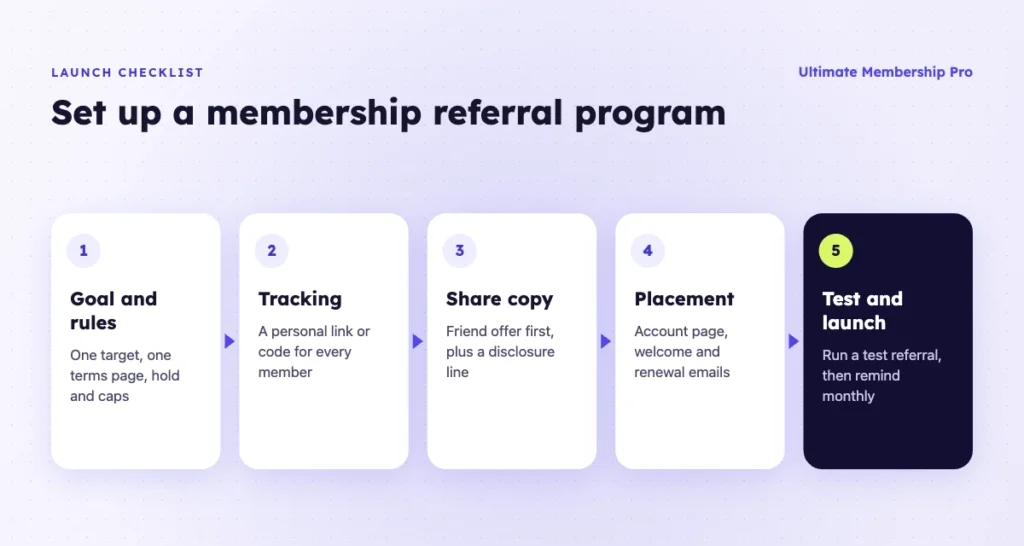
Setting up a membership referral program takes seven steps, from goal to launch.
- Set one goal. For example: 10% of new members from referrals within six months.
- Write the rules. Who can refer, the rewards for both sides, the hold period, the cap and the fraud rules, on one short terms page.
- Set up tracking. Give every member a personal link, a personal code or both.
- Write the share copy. A short message that leads with the friend’s reward and includes the disclosure line.
- Put it where members already are. A tab on the account page, a line in the welcome email, the monthly newsletter and the email before each renewal.
- Test the full path. Refer a test account, pay with a test card, and check the referral, the reward and the payout.
- Launch and remind. Announce it to all members, then mention it monthly, plus a short campaign twice a year.
The best moment to ask is right after a member gets value: after they finish a first lesson or project, after a live event or after a renewal. If you’re refining that first month, these member retention strategies pair well with a referral ask.
Which metrics show your referral program is working?
Four numbers show whether a membership referral program is working. Measure them monthly and compare each month with the last.
- Participation rate: members who shared their link at least once, divided by all active members.
- Referral conversion rate: referred friends who paid, divided by referred friends who visited or signed up.
- Share of new members from referrals: referred paying members divided by all new paying members.
- Retention of referred members: how many referred members renew, compared with members from other sources.
For example, if 500 active members get the offer and 40 share their link, participation is 8%. If those links bring 50 visitors and 12 of them pay, the referral conversion rate is 24%.
Low participation usually points to a hidden program or a weak reward. Low conversion usually points to a weak friend offer or a confusing landing page.
How do you run a membership referral program on WordPress?
On WordPress, you can run a membership referral program with Ultimate Membership Pro, which sells and bills Memberships, and Ultimate Affiliate Pro, WPIndeed’s affiliate plugin, which tracks who referred each new member. Ultimate Affiliate Pro is sold separately; the Ultimate Affiliate Pro integration itself is built into every Ultimate Membership Pro plan.
- Activate both plugins. No connector is needed: Ultimate Membership Pro is on by default under Ultimate Affiliate Pro › Integrations, and a Membership bought through a member’s link records a referral.
- Add the Affiliate tab. Under Affiliates › Account Page, turn on Show the Affiliate tab, so a Become Affiliate button appears in the Member Portal.
- Enroll existing members in bulk. Filter the list under Ultimate Membership Pro › Affiliates and use the Make affiliate bulk action. For new users, Ultimate Affiliate Pro can make everyone an affiliate automatically.
- Set the referrer’s reward. Use a percentage or fixed amount per rank, or a Product Rate for chosen Memberships. Leave recurring referrals off for a one-time reward.
- Create the friend’s offer. Add a coupon in Ultimate Membership Pro, limited to some Memberships and a number of uses. For a free first month on a recurring Membership, set it to the first payment only at 100%.
- Link codes to members. Assign a coupon to a member in Ultimate Affiliate Pro. Anyone who uses it at checkout is credited to that member, even without the link.
- Exclude taxes. If you charge tax, turn on Exclude Taxes from Calculations so rewards use the price before tax.
- Pay once a month. In Payouts › All UnPaid Referrals, select only referrals older than your hold period and pay them through PayPal, Stripe or bank transfer.
The Ultimate Affiliate Pro integration guide walks through each setting, and the subscriptions and coupons page covers trials, bulk codes and gift Memberships.
Know the limits
- Approval does not wait for refunds. A referral is approved when the payment completes. Ultimate Affiliate Pro’s pages don’t say how a later refund of a Membership payment changes it, so check before each payout and leave out referrals whose payment was refunded or disputed. A reward already paid is recovered under your terms.
- First-payment coupons work only at 100% on some gateways. On Stripe and Braintree, a coupon that applies only to the first payment of a recurring Membership works only as a 100% discount. A free first month works there; 50% off the first month does not. A free first month also makes the friend’s first charge $0, so a percentage reward on that sale is zero: test how your setup records it, and release the referrer’s reward only after the friend’s first paid month.
- Personal codes take admin time. Bulk Coupons creates up to 100 codes at once, but each code is assigned to a member by hand. With 100+ members, put one shared friend coupon in the share message and let each member’s link do the tracking. Keep personal codes for members who share offline.
- Self-referrals stay off. Ultimate Affiliate Pro’s Allow own Reference module, listed as Affiliate Own Referrals in its Full Package, lets affiliates earn on their own purchases. Leave it switched off.
- Members see affiliate wording. The Affiliate Portal shows their links, stats and earnings. Payout requests and the fraud protection module are in Ultimate Affiliate Pro’s Full Package plan.
How to give free time instead of cash
Ultimate Affiliate Pro records rewards as commissions. To give a free month, move the member’s Expires On date one month later under Members › Manage Plans. The gateway still charges on its usual date, and the next payment adds its period to the later date, so the month is kept. The guide on changing a paying member’s dates explains it.
Each edit is made one member at a time, so batch them once a month, or switch to a fixed-amount reward paid with your monthly payouts once volume grows.
Simple invites for free communities
If you don’t need rewards, the Invite Your Friends add-on adds a tab to the Member Portal where members email invitations to friends, with a link to your registration page. Members see who joined, and you cap invitations per member. It is a Pro add-on, included in the Full Package and Agency plans.
Ultimate Membership Pro is sold as annual plans (Pro, Full Package, Agency), with unlimited members on every plan. Payment processor fees still apply.
Ready when you are
Turn visitors into paying members with Ultimate Membership Pro
Launch your membership website, protect exclusive content and automate subscription payments, all in one WordPress plugin.
- 14-day money-back guarantee
- Unlimited members
Frequently asked questions
What is a membership referral program?
A membership referral program rewards existing members when a friend they invite joins and pays. Each member shares a personal link or code. When a referred friend becomes a paying member, the referrer earns a reward such as a free month, a discount or credit, and the friend often gets a discount too.
What are good referral rewards for members?
The best referral rewards tie back to the membership: a free month, extra access time, a discount on the next renewal or account credit. They cost you less than cash and keep members using the site. Cash commissions suit high-value plans or members with an audience, and recognition such as badges works well in communities and associations.
What is a member-get-member program?
A member-get-member program, also called member-get-a-member, is a referral program where current members recruit new ones, usually with a reward for both sides. As of October 2026, for example, AARP gives a referred friend a special membership offer and pays the referring member $15 once the new member has stayed active for 60 days.
When should you pay out a referral reward?
Free time or credit can go out as soon as the refund window closes, for example on day 15 with a 14-day refund policy. Cash carries more risk, because card disputes can arrive up to 120 days after a payment. Hold cash 30 to 60 days, or longer for less risk, and cancel rewards on refunded or disputed payments.
What is the difference between a referral program and an affiliate program?
A referral program rewards customers or members for personal recommendations, usually with free time, discounts or credit. An affiliate program pays partners with an audience, such as bloggers or podcasters, a commission on the sales they bring. You can run both on one site, with different rewards and rules for each group.
Can you run a membership referral program on WordPress?
Yes. A membership plugin handles sign-ups and payments, and a referral or affiliate plugin tracks who referred whom. With Ultimate Membership Pro and Ultimate Affiliate Pro, sold separately, members join from their account page, share a link or a coupon, and you approve and pay rewards from the WordPress dashboard.